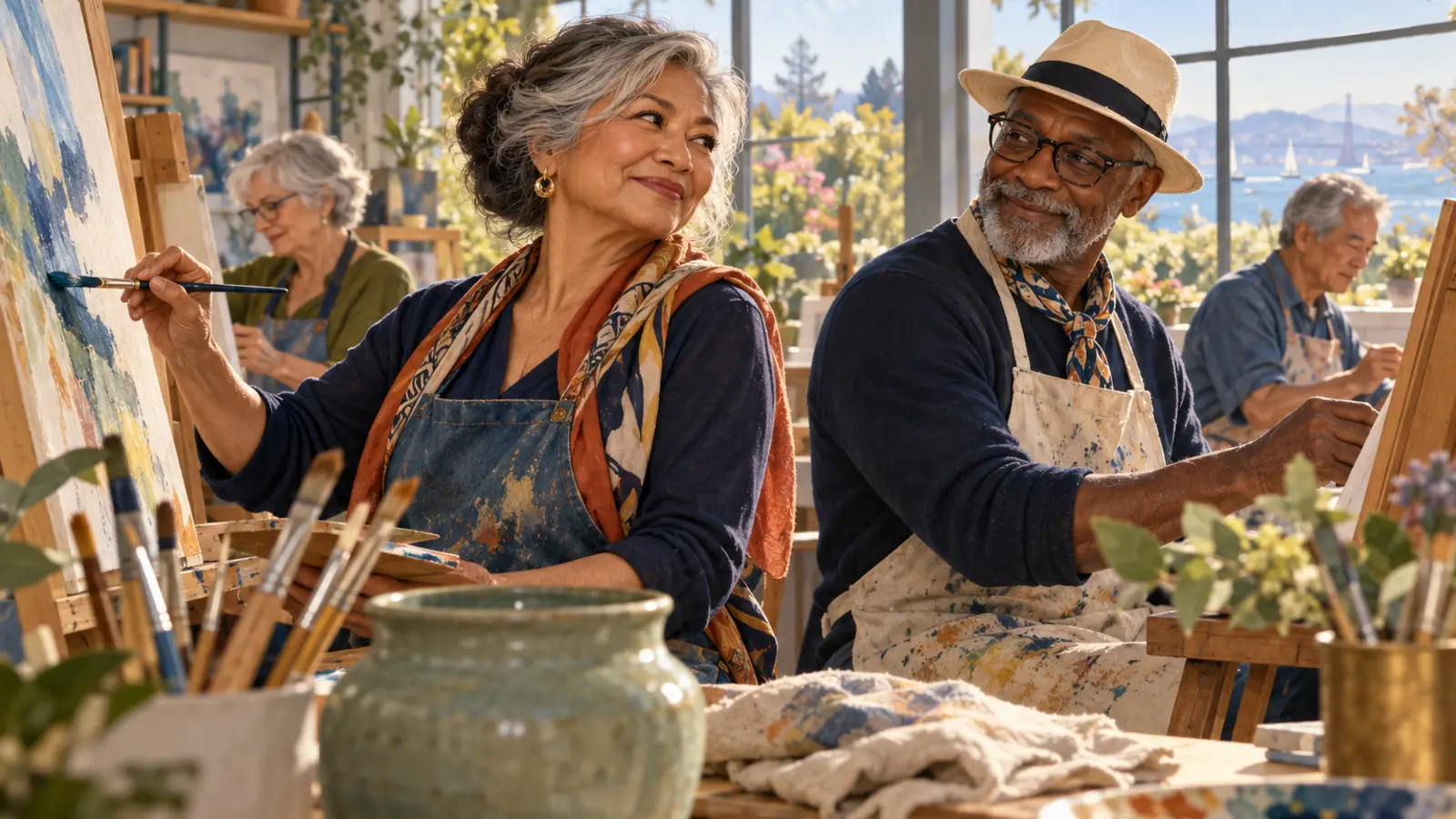
Choose curiosity over performance
Many adults hesitate to enter a class or hobby because they believe everyone else will already know what to do. But a beginner is simply someone paying close attention. The first uneven line, missed step, or unfamiliar word is evidence that you have started—not that you have failed.
The National Institute on Aging encourages older adults to take part in enjoyable social and productive activities, including art, dance, language, and computer classes. Research on creative participation is promising, but no single activity guarantees a health result. The most useful choice is often one that feels interesting enough to return to and realistic enough to fit your life.
Make the doorway smaller. Attend one class, borrow materials before buying them, or give yourself twenty quiet minutes at home. If standing, gripping, hearing, vision, transportation, or energy creates a barrier, ask about seated options, larger tools, better lighting, quieter times, or accessible instruction. Adaptation is not cheating; it is good design.
“A first attempt does not need to prove anything. Its job is only to make a second attempt possible.”A practical thought for active aging
Give your eyes and body room to enjoy the work
Close work is easier when the setup serves you. Bring the project toward you instead of bending toward it. Use a supportive chair, keep frequently used items within comfortable reach, and choose clear, even light that reduces glare. Pause now and then to look across the room, relax your hands, change position, and notice whether fatigue is taking the pleasure out of the activity.
Vision changes deserve attention rather than assumption. The National Eye Institute notes that many eye diseases have no early symptoms and that comprehensive dilated eye exams can help detect problems early. How often you need an exam depends on age, history, symptoms, and individual risk, so ask an eye-care professional what schedule is appropriate for you. New flashes, a curtain or shadow in vision, sudden vision loss, or eye injury call for prompt professional evaluation.
Good lighting, current glasses, high-contrast materials, and larger print can support comfort, but they do not replace an eye exam. The aim is not to make every project effortless. It is to remove avoidable strain so curiosity has room to stay.
An original two-part story · Part One
The Accidental Sky
Elena Cruz had spent forty-two years correcting other people’s numbers. She could spot a misplaced decimal from across a conference table, remember the exact total of a grocery receipt, and make a household budget behave without raising her voice.
Paint, however, refused to behave.
On the first morning of the beginner’s watercolor class, a bead of blue rolled down Elena’s paper, crossed the careful pencil line of a flowerpot, and settled where the table was supposed to be.
“Well,” she whispered. “That is ruined.”
The man at the next easel leaned sideways. He wore a straw hat indoors and had tied a navy scarf around his neck as though the community center were a café in Paris.
“Or,” he said, “your table has become the sky.”
Elena looked at him. “Tables do not become skies.”
“That is why painting is more exciting than accounting.”
She had not told him she was an accountant.
“Your tote bag,” he explained, pointing to the faded letters: CRUZ & PARTNERS, CERTIFIED PUBLIC ACCOUNTANTS.
Elena folded the bag so the words disappeared. “Retired.”
“Congratulations. I’m Walter Brooks. Also retired, though from teaching sixth grade, which means I am very comfortable with things refusing to behave.”
At the front of the room, their instructor, Mina, asked everyone to loosen their grip on the brush. Elena looked around. Eight classmates were making cheerful puddles. No one appeared concerned about straight lines.
She had enrolled because her daughter had said, gently but too often, “You need something that isn’t an errand.” Elena had objected that errands were useful. Her daughter had replied that usefulness was not the only reason to leave the house.
Now Elena touched the blue streak with a damp brush. It widened. The flowerpot vanished beneath a wash the color of early morning.
Walter nodded. “There. Definitely a sky.”
“It has a pot floating in it.”
“A brave pot.”
Elena laughed before she could stop herself.
For the rest of the class, they traded observations in whispers. Walter’s apple resembled a red balloon. Elena’s lemon looked like a small moon. When Mina reminded them that the exercise was about noticing color rather than producing a masterpiece, Walter underlined the sentence in his notebook.
“Do you always take notes?” Elena asked.
“Occupational hazard.”
“I made a spreadsheet of the supplies.”
“Excellent. Between us, art has no chance of escaping.”
At home, Elena set her painting on the kitchen counter. Every time she passed it, she saw the mistake first. But by evening she also noticed the blue: uneven, translucent, and brighter where the paper showed through. It reminded her of looking toward the bay just after sunrise, before the day decided what it would become.
The following Thursday, she arrived twelve minutes early. Walter was already there, arranging two jars of water.
“One for clean water,” he said, “and one for the color that becomes soup.”
He had brought her a square of cardboard to place under her paper so she could turn it without reaching. Elena had brought him a printed supply list with checkboxes. Neither mentioned the exchange.
Week by week, their corner of the studio developed a rhythm. They compared brushes, opened stubborn paint tubes for each other, and took breaks near the window when their backs complained. Elena learned that Walter lived alone in the house where he had raised two sons. Walter learned that Elena’s husband, Tomas, had died six years earlier and that she still sometimes bought two avocados without thinking.
They did not rush to repair each other’s sadness. They painted beside it.
One morning Mina placed a vase of sunflowers in the center of the room. “Paint what you notice,” she said, “not what you think a sunflower is supposed to look like.”
Elena noticed that one flower leaned away from the others. Its petals were smaller, its stem bent, and yet its face caught the strongest light. She painted that flower alone against a deep blue background.
Walter grew unusually quiet.
“What?” Elena asked.
“Nothing.”
“You were a teacher. Your face is still giving grades.”
“It is beautiful,” he said. “And I know you will argue, so I will add: it is also brave.”
Elena looked at the bent stem. “The flower or the painter?”
“Yes.”
At the end of class, Mina announced that the community center would hold an open house in November. Each class could choose one piece for the lobby exhibition.
“No pressure,” she said. “We’ll decide together next week.”
Elena packed her brushes quickly. Public display was different from a classroom table. A classroom could forgive. A lobby had lighting.
The next Thursday, her sunflower painting was missing from the drying rack.
Walter’s hat was on his chair, but Walter was nowhere in the room.
Then applause rose from the hallway.
Elena followed the sound and stopped beneath the lobby’s tall front window. Her blue-sky sunflower hung on the wall in a plain maple frame. Below it was a small card with her name—and beside it stood Walter, Mina, the center director, and a local reporter holding a camera.
“Walter,” Elena said slowly, “what did you do?”
He removed his hat.
“Before you become angry,” he said, “there is something you should know about the vote.”
To be continued November 7
Elena discovers why the class chose her painting, what Walter kept from her, and how one accidental sky becomes a public invitation neither of them expected.
Original story created for Senior Care Compass Newsletter · Part One of Two